Training for a thru-hike…..

487-e1513373122780.jpg

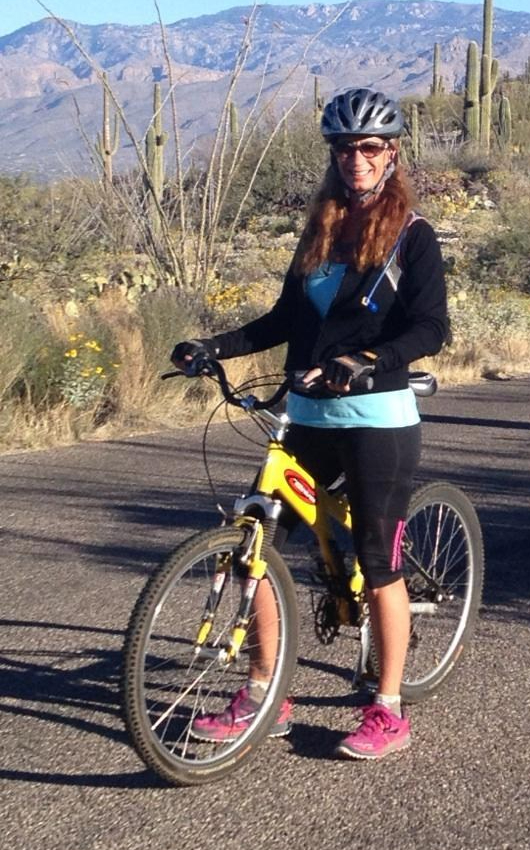
Riding a bike is great cross training for hiking

Well there is more to it than that: Being healthy and fit for a day hike is significantly different than being healthy and fit for a thru hike. Our body and minds need to be ready for the trail. Not to mention the detailed planning that goes into a thru hike adventure which we will discuss in another blog. But the training can start NOW! “The better the train, more the gain on the trail” ……says not just me. The idea of a week-long to a month long thru hike is romantic in my mind given that I will be out in the beautiful-middle-of-no-where-wilderness with all I’II need to survive on my back dependent on only myself-awe!!! That’s pure love. I don’t mean that selfishly I mean it supportively to the idea that self-reliance, self-confidence, basic survival skills and gaining the ambitious belief “I CAN DO IT!” is my means of attack for the encompassing objective in preparing and planning a thru hike. So, with members of my tribe we are working to increase our stamina, endurance, core strength and our confidence to be as successful as possible on our future journey on a section of the PCT (Pacific Crest Trail) from Yosemite to Tahoe where will make memories that last a life time.

The tribe members joining this journey in July 2018 will be Gwen, myself, Gina, Katie and Brenda. My goal has been to hike the entire length of the Sierra-Nevada’s after completing the JMT (John Muir Trail) with Gwen in 2016. The JMT was Gwen’s pick; this section of the PCT is mine (we take turns picking our adventures). Gina and I hiked Guatemala together summer of 2017 and she fell in love with that part of the trip craving more adventures. Katie wants more time on the trail after her introduction of 2 days on the JMT (read: Gwen’s “Ignorance is bliss” blog). And Brenda is new to hiking and backpacking but very eager with several weekends and overnights under her belt. Gwen, Gina and I will start in Yosemite with Katie and Brenda joining use a week later at Sonora Pass to finish the second half of the 152-mile section ending in Meeks Bay. This is all very exciting to think about but physically challenging to complete.

I have made additional summer commitments beyond the 152-mile hike following the weekend after our completion. They include but aren’t limited to hiking with my son, Cole, from Yosemite Valley to Tuolumne Meadows including hiking Half Dome, and then the next week we are off to Alaska for salmon fishing and finishing with a half marathon in Anchorage. So, training can’t start soon enough for me. No one needs similar goals to find self-motivation to improve personnel fitness. Where ever you are and whatever your objectives are you can implement a training program to fit your needs or follow the one below. It is a simple comprehensive muscle building, core strengthening, endurance increasing workout plan. Take what you need and go for it!

Note: The section of the PCT we are doing has no elevation gains greater than 4000 feet. There are summits that will be challenging with our back packs weighing between 32-45 pounds.

Remember building all we need within us is a process over time….and we are what we eat. Eating healthy and drinking lots of water is important. Always have fun and respect your limits. Avoid injury by NOT doing too much too fast…. start somewhere but start slow if just beginning to train. A day of rest can do your body and mind wonders. To work out with tribe members is beneficial, motivational and keeps you accountable.


Training for a thru hike:

“The difference between a dream and a goal of a thru-hike: An action plan in place to gain momentum for the changes your body will need to achieve your dream while gaining the confidence you need to follow through.”   -BK

HINT: Make a commitment to the days per week for training and stick to it

Cardio and endurance is essential

-hiking steep and difficult trails for a minimum of 2 hours once a week (increase distance and time bi-weekly-gradually)

-challenging quick-paced cardio workout (running, treadmill, biking or stairs) with incline increasing over time for 1 hour a day

-engage in fitness class as an alternative for a shake-up to muscles 1 hour a week (swimming, abs of steel tape, Les Mils at a gym or boxing)

Core strength is imperative

-weight train 3 times weekly for a minimum of ½ and increase weight over time (do 2 to 3 sets of 15 repetitions of each exercise working arms, legs and core)

-yoga, TRK, good old calisthenics or swimming improves core strength (calisthenics: jumping jacks, wall sits, push up, abdominal crunches, chair set-ups, squats, side lunges, squat jacks, high knee shuffle, ski umps, chair tri-cep dips, plank, high knee running in place and mountain climbers to name a few that can be done in circuit form and done twice with 30 second rest between 1 minute of 13 exercises)

– stretching after a good hike or work out is the best time to stretch because you are warmed with blood flowing through your muscles. Basic stretching after each workout will decrease soreness and increase your range of motion

– Varying exercises with increase of time, incline, distance and weight improves stamina and overall benefits of training

Our tribe starts TODAY! We are starting with the stairs at McKale Center (@ U of Arizona their basketball stadium). We will run up and then down all of stairs for an hour -around and around we will go. We are trying to exercise be it hiking, walking, running or swimming 5 days a week with a long hike at least once a week. This Sunday we are doing Blackett’s in Sabino Canyon National Park which is a total of 8-miles, but the last leg of it is up 1.7 miles with a 1700-foot elevation gain. Tucson tends to have awesome winter weather making outdoor training easy and a multitude of diverse types of hiking trails to choose from. And the stadium stairs for not-so-good weather days. We will start adding weight to our backpacks and do a few shake-out overnights that will prepare our bodies to carry the weight of our packs on the 14-day journey.

Start today……. stick with it! You will only get better!

-Kat
IMG_0152

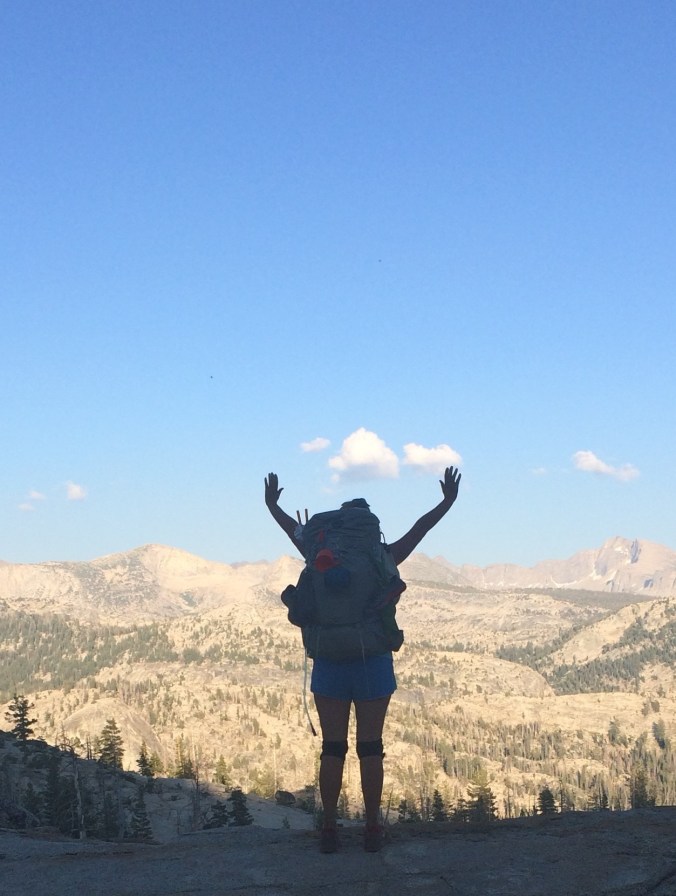
Looking in the direction I am headed… believing I CAN DO IT!
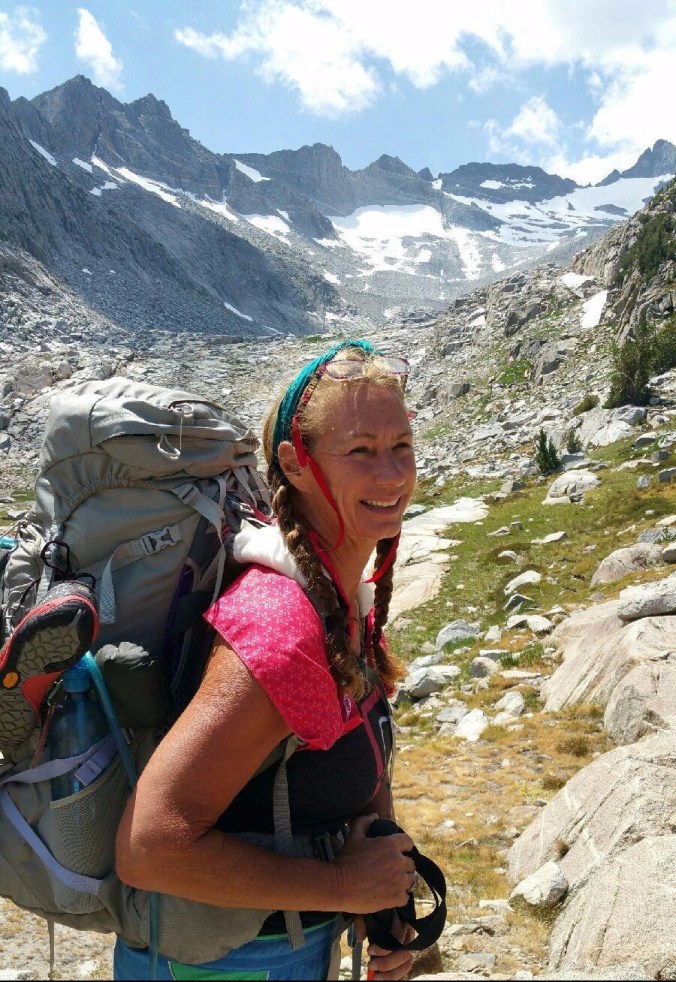
Gear you can’t live without…

img_0325-e1512774736401.jpg

Backpacking can be incredibly exciting while seeing untouched outdoor locations. Putting all the gear together can be costly to start. Carrying it all can be heavy but not having it is the difference between loving your experience or never wanting to go again. So, the preparation with through thought and a bit of anticipation that you will eventually need everything for a longer thru-hike is a great starting place. Or you could be like Gwen and I who set our sights on a goal of 200+ miles through the wilderness for our first major thru-hike. I had back packed before the John Muir Trail (JMT) but only for weekend outings that my aged exterior framed backpack that only held weekend supplies would never do for a 20-day hike on the JMT. And it also meant that my day pack for those weekly outings in our local areas wouldn’t do either as it only holds my water supply and snacks for a day hike.

Gwen and I had to gear up for a major thru hike and we were basically starting from scratch. The debate between ultra-light and not so ultra-light is yours to have with yourself. We had our own internal and external arguments about this topic but the 20 days on the trail ended up being the experience we needed to make up our minds. There are great reasons justifying either position. Being somewhere in the middle for weight could be a happy medium. The idea that makes weight a considerably important thought is “grams equal ounces, ounces equal pounds and pounds equal pain”. With that in mind I’m sure you’ll come to your own comfort level. And whatever weight you choose remember you will feel it all as you hike the trails your planning on exploring.

Buying your gear is making a financial commitment to your new-found passion. The physical training flowed easier for me after I spent all the money in preparation for our through hike. I also realized once you are all set up and dialed in with your gear it will serve you well if you take care of it. There are big ticket items that you just don’t want to skimp on like your bedding (a bag or quilt), your bed pad you sleep on to insulate from the ground you are laying on and your tent. But most importantly is the back pack you choose to put it all in because everything you need will be on your back. To be accurately fitted for your pack and it being the size you will use now and in the future, is important.

GEAR LIST:

Big ticket items ….

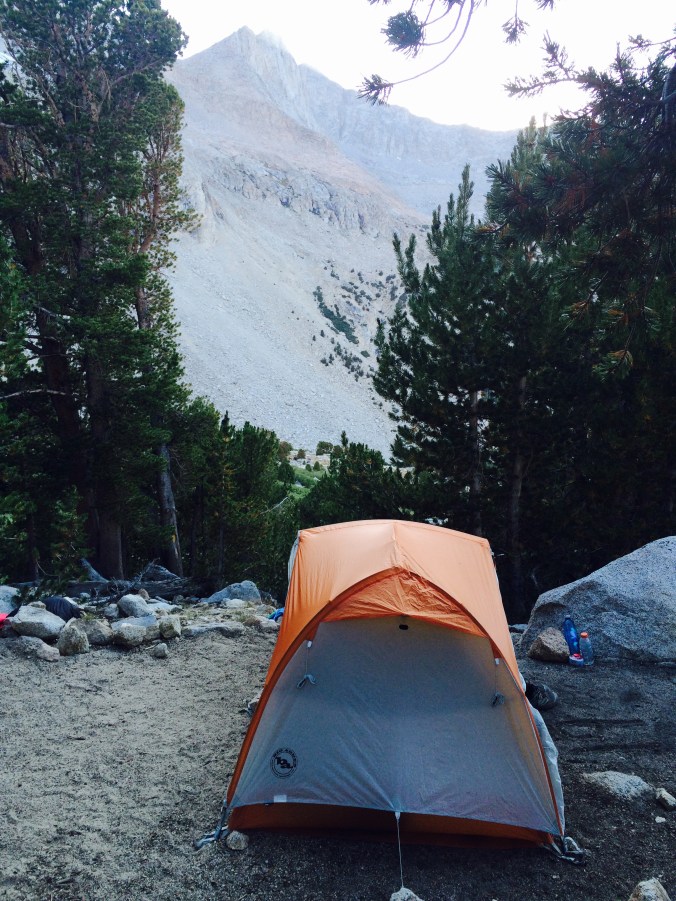
Tent- I chose a 2-man tent because I liked the extra room and didn’t mind the extra weight

IMG_1406 (1)

my home away from home

Back pack – get fitted at your outdoor shop

Sleeping bag or quilt -make sure you get one that the temperature will be right for your environment you will be in-sleeping bag liners can add additional warmth

Sleeping pad -the R value is important to your level of warmth at night (the higher the number the greater the warmth) and the thickness of the pad equates to your comfort

Not such big-ticket items ….

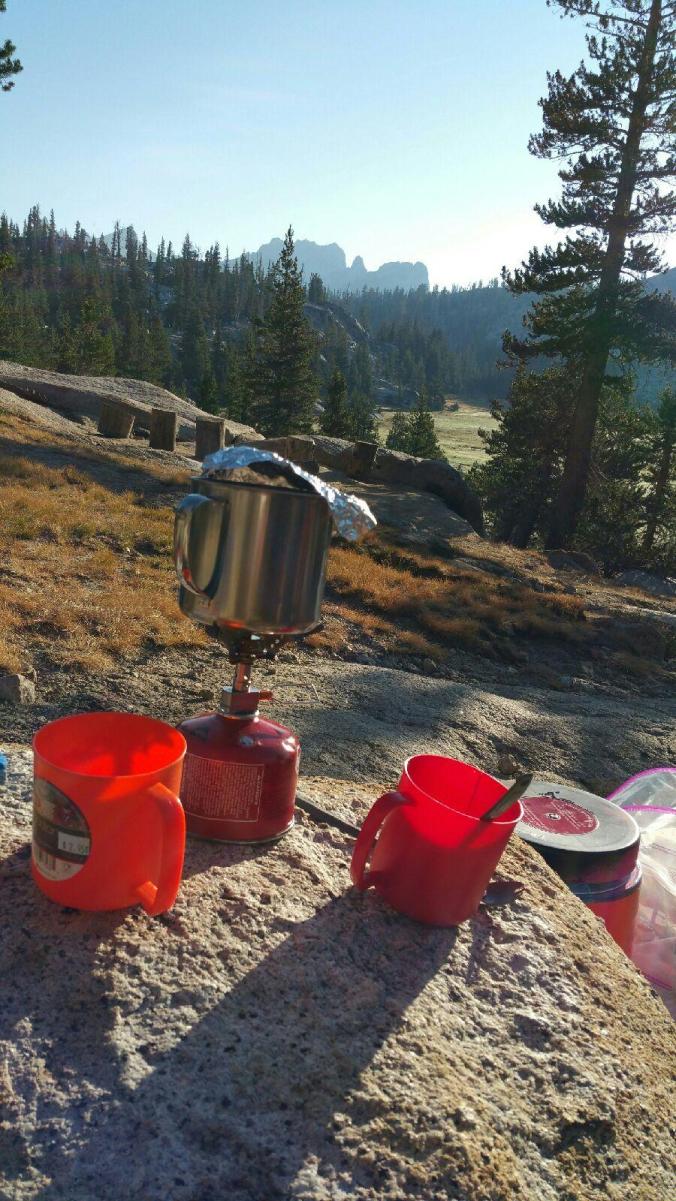
Stove -the Jet Boil is super-fast and kinda big compared to the pocket rockets sold on line that easily screw onto the fuel can while taking up little space in pack because they can be stored in a stainless-steel cup that you use for water boiling.

Water filterKatadyn is super-fast, but bulky compared to the mini sawyer. For a thru hike I recommend the Katadyn and the mini sawyer as a backup water treatment.

Water source containers -these could be bladders or bottles. I prefer the 32 oz. bottles with the adaptor on the top that has a mouth piece and a hose that screws on in place of the cap. There are available on line and they save space in your pack because they can be stored on the outside of it verses the bladder on the inside. Exterior bottles it is easier to monitor your water supply while hiking.

Trekking poles – These are multi-functional for better use of physical energy. They improve your cardio work out and aid in over balance on rough terrain. They also reduce weight on knees 30% and help to slow or reduce fatigue (the power lock poles versus the screw type are better). It is also a suitable place to wrap your duct tape or medical tape supply around so that you will have it for repairs if need. Duct tape and a sharpie are musts for day hikes to thru hikes. Sharpies are great for first aid to mark injury times and monitor swelling.

Of course, you will also need a means of navigation (a map or gps-I used Inreach Garmin with 2-way communication via satellite and down loaded maps-that is a big-ticket item), permits if required and a journal with means to write. Your clothing should be in layers for all different types of weather, wicking and include Merino wool as it doesn’t smell after days of wearing it. I like to hike in running shorts and tank tops which are easy to wear under long pants and additional top layers if needed. I wear one set of clothing and then I can wash out the other, so I always have a clean (relatively) set of clothes. Clothing also consists of sleepwear (merino wool tights, t-shirt and undies-2 pair one to wear and one to wash out), down jacket, rain jacket, beanie, sleep socks (super comfy and they add warmth), hiking socks (again two pair-one to wear and one to wash out) and gloves. I also have one pair of long pants and one long sleeve shirt.

You will need fuel, water proof matches and a lighter. Make sure you have a basic first-aid kit and include lots of Ibuprophen or Tylenol for the aches and pains of thru-hiking. I liked to sleep with ear plugs too. A flashlight and head lamp are also important. There are solar light-weight lanterns out now that are awesome. Extra batteries weigh but you’ll need them unless you have a solar charger (another big-ticket item). A Swiss Army or Leatherman knife with multi-tools is a must and consider its weight. The stuff sacks available make organization of your supplies, clothes and toiletries much easier. Sunscreen, lip balm and dehydrated baby wipes reduce weight and make clean up without water at least feel fresh. And a quick -dry towel and washcloths are a must for bathing with bio degradable soap. I also like a bandana tied on my pack for a sweat rag. A spork to eat with is essential as is a bear canister in bear country or a sack for food to hang in a tree and then you’ll need rope (nylon or light weight at least 50’) which is a must anyways for a clothes line, swift water crossings or other applications.

Your foot wear is extremely important and should be worked out prior to long hike. I preferred light weight trail runners, not boots, but everyone is different. A pair of camp shoes that can double as water shoes is nice to give your feet a break. A poop bag is handy so not to pollute the outdoors. I make mine out of hardy Ziplocs covered in duct tape (so not to see contents) …it really only holds used toilet paper. A wag-bag is a whole different story that those who have done Mt. Whitney are well aware of wag-bags. You will also need a shovel to dig your potty holes. They make very light weight shovels. And extra Ziplocs are useful for your trash. Bear spray (if allowed) is weighty but it works, and insect repellent is also good to have. Pre-spraying Permethrin on all your clothes, sleeping bag, tent and backpack works well for insect repellent.

IMG_0321

Pocket rocket with coffee cups waiting for a fill up

IMG_0281

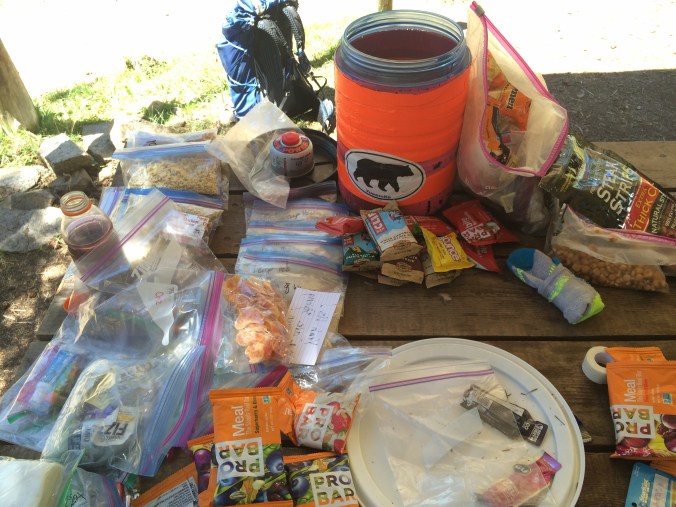
Re-supply time…it all had to fit in the bear canister

Food:

NOTE: It is important to taste your food before that is all you have to eat in the middle of no-where and you figure out you don’t like it!

For a general rule of thumb your food choices should have at least a 100-calories per ounce of food. Your daily consumption of food on trail will go up with your calorie burn through exercise. I liked to have three meals, two of them hot (breakfast and dinner), and as many as three snacks plus gummies or blocks for the demanding summit climbs.

If carrying a bear canister all your food needs to be re-packed to fit into the canister. Ziploc freezer bags are great for dual purpose of re-packing and then to cook the food in them. The dehydrated food can be re-hydrated in the freezer zip locks by just adding water to it. I love oatmeal so that can easily be my breakfast every morning. You can add nuts and dehydrated fruits as well as protein powder to your oatmeal to make the calories count and the taste better if need be. I also like my tea with sweetener every day and Gwen enjoys a cup of coffee with instant breakfast in too for flavor and additional protein.

My lunches are “pro bars” that are packed with calories and small to carry. My snacks are an assortment of protein bars I have come to love. Peanut butter Balance bars are my favorite. And Cliff Bloks were imperative to my ability to make it up and over summits. I love these too – energy jelly beans or PRO BAR gummies. They are all made for “during workouts” with high carbs for quick energy. They work well. And they taste yummy too!

The tuna packages are also great for lunch and tortillas with preservatives last a long time. Peanut butter and jelly in small packages are also yummy on tortillas.

Electrolytes can prevent cramps so supplement your diet with while hiking. I like the water flavor types that come in small squeeze bottles but there are many types to choose from. I recommend you use electrolytes at least one time daily. Again, pre-taste them too.

I bring additional salt packages but that is just me. I did find day in and day out that Top Ramen for dinner is yummy, but the entire season package contains a lot of salt, so I ultimately used only half of that at dinner or I would be thirsty all-night long.

This list is not inclusive of all that you should bring but it a good place to start if you have never gone backpacking before. Experience is the best teacher but being over prepared is better than under prepared when you’re in the back country. Hiking with a buddy can reduce weight you each if you can share. Hopefully this is helpful and useful information.

May all your trails be happy!

-Kat

IMG_0056

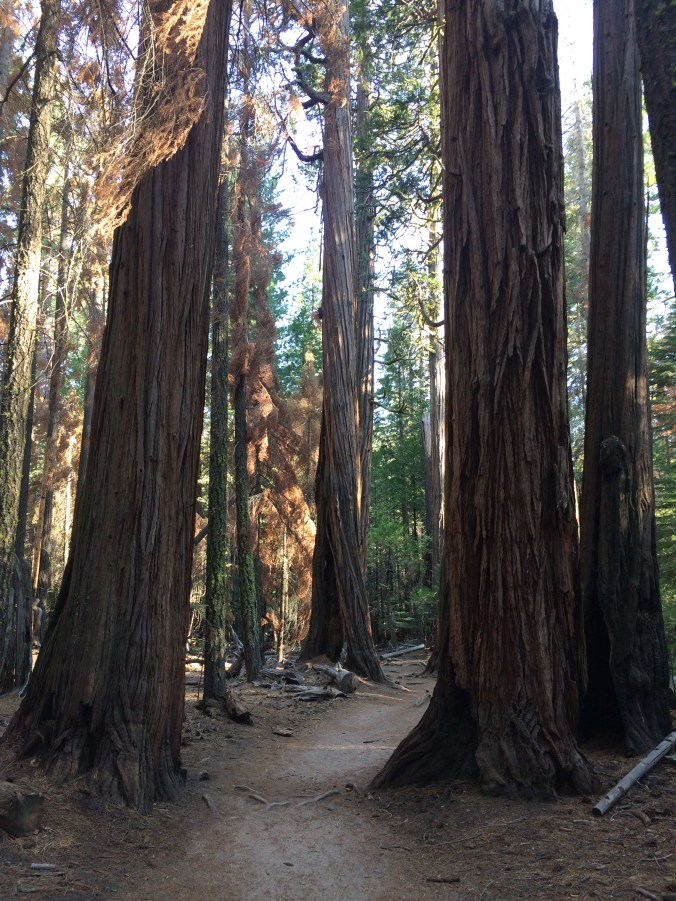
Walking through some of the big ones on the JMT

Benefits of Hiking and Beyond…


John Muir once said, “In every walk with nature, one receives far more than he seeks.”

Snack time an additional benefit of hiking

Snack time is an additional benefit of hiking!

Hiking is a fantastic way to “use it or lose it” and to gain mental health benefits from being outdoors in nature. I am a chronic pain, fibromyalgia patient who broke my neck and jacked my back almost 30 years ago in a car accident. I look normal and try to act normal, but I know I have become a master at masking my pain. Pain is pain period. Not feeling good or not feeling motivated are powerful physical and mental sensations that gain power and momentum all on their own if we let them. If I’m going to feel awful sitting in a chair why not feel awful breathing fresh air?  Fibromyalgia, chronic pain and hiking all sound awful in the same sentence for some…. but for others it “can” define us. But I refuse to allow that and I beleive….Just fake it until you make it sounds simple and it is.  I hike to feel better.

The noted benefits for outdoor walking or hiking continue to expand with research. Research shows that everybody can benefit with better overall health from hiking. Getting up and out can reduce your stress and increase your energy. The more you do the better you will feel. You must start moving and then keep it up to get the consistent benefits of a hiking. As with anything start slow and start planning unfamiliar places to explore. If you can hike at least 30 minutes a day-4 days a week you will start to see the benefits. Ultimately your goal should be to hike an hour a day-4 days a week. If you were to do more vigorous exercise such as running, backpacking with weight or hiking uphill you would need half the amount of time to obtain the health benefits. Utilizing hiking poles decreases stress on your knees by a said 30% and increases an upper body workout during your hike. They also help in balance for rough terrain and help going up or down hills. Poles help reduce hand swelling that may occur and increase your cardio workout.

Hikers are said to be happier. The mental health benefits are endless. Just being outdoors and observing Mother Natures beauty is stress reducing. Hiking alone can increase your self-confidence (but take solo hiker precautions-safety first). Or hiking with members of your tribe is a wonderful time to discuss issues, brain storm current ideas and continue to bond. It’s your choice to make a solo hike for a spiritual experience or being with friends as a social experience. Whatever works best for you is what you should do. And while you are just out there enjoying yourself be aware that the following benefits of hiking are working for you.

Hiking’s health benefits are as following:

Improved cardio-respiratory fitness

Improved muscular fitness

Lower risk of coronary heart disease and stroke

Lower blood pressure

Reduced risk of diabetes 2

Lower risk of colon or breast cancer

Lower risk of high cholesterol and triglycerides

Increased bone density or a slower rate of loss

Reduced depression

Better sleep

Weight control (hiking can burn 350 calories an hour or more)

Spending time outside increases attenti)on spans and creativity

Improves anti-oxidative capacity (helps to heal from cancer

With the above list of all the possible benefits hiking can provide to you and your over-all health, it can inspire you to engage in a healthier lifestyle. It certainly has done that for me. I absorb the beauty I hike in and never fail to be intrigued by the amazing perfection of Mother Nature. What happens to me when I hike makes be feel seduced by the fresh air and energized to see what lies around the corner. I can honestly feel painless at times. I would much rather help my health hiking then sitting in a chair and feeling bad. At least when I am sore after a hike I feel as if I earned the aches from walking the miles I just accomplished.

Bottom line……pain or no pain Hiking is good for your over all health….so let’s get out there and explore more!

-Kat